ARCHAEOLOGICAL EXCAVATIONS OF THE SETTLEMENT OF “DIDNAURI”
May 18, 2026
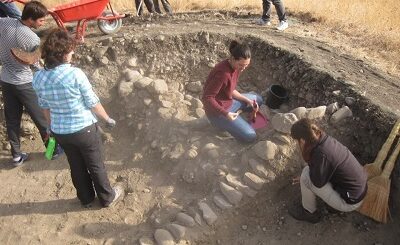
The settlement of “Didnauri” was discovered in the western part of the Great Shiraki Valley, in the territory of the Dedoplistskaro municipality. According to satellite photos, the settlement covers an area of 35 hectares. Dry beds of the rivers Didnauri, Chaliankhevi and Didi Rui are visible in all three valleys located here. There are fifty small settlements on the hills around the valleys, which date back to the 12th-9th centuries BC. The settlements represented a single socio-economic and political unit, the socio-economic and administrative center of which was the settlement of “Didnauri”. Presumably, this is the largest settlement in the South Caucasus. It is surrounded by a 7-meter-wide and 1.5-km-long fence built of stone, clay, and wooden structures. There are large buildings in the northwestern and northeastern corners of the city. The city’s water supply system has also been found. During the excavation of the southern part of the wall, two ritual buildings were found near the gate, the so-called “sacrificial table”, which has parallels in the Hittite world, and one residential building.
A large amount of archaeological material has been found: gray-fired clay vessels, stone weapons, clay seals, and fragments of bronze objects.
A necropolis of the 13th century BC was found in the north of this city-state. It contains about 50 tombs, where noble men, whose height is on average 180 centimeters, are buried. As a result of DNA analysis and anthropological research, it turns out that these about 50 people belong to the Caucasian race.
The city existed for over two hundred years and was then probably destroyed by an earthquake or sacked by an enemy.